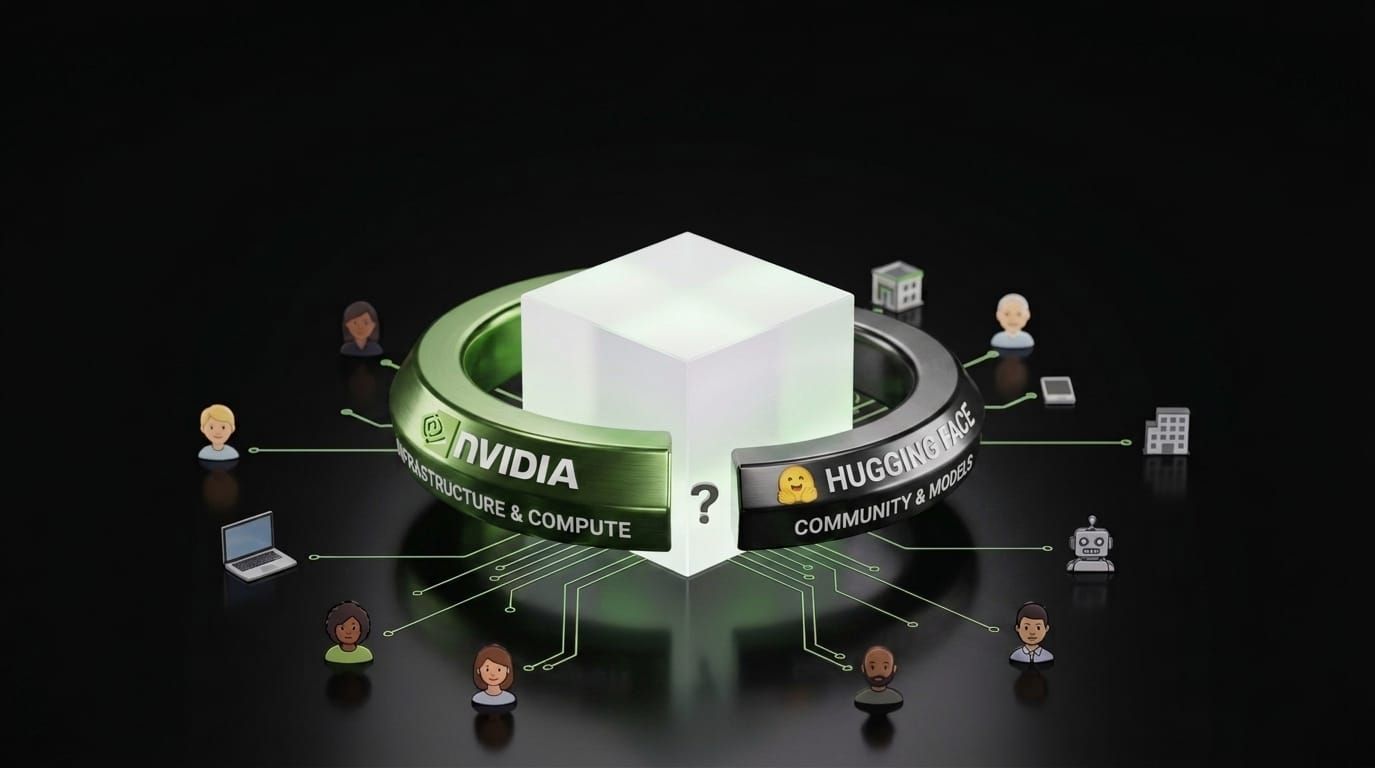
Who Owns the Open-Source AI Town Square? The NVIDIA–Hugging Face Deal Changes the Answer
By Garrett T. Willis, MBA
Meta: NVIDIA reportedly agreed to buy Hugging Face for $12.9 billion. What that actually means for the open-weight models you run on your own hardware — and what it doesn't.
If you've ever downloaded an open-weight model — Qwen, Llama, DeepSeek, any of them — you used Hugging Face. It's where the weights live, where the community gathers, where the transformers and diffusers libraries come from, and where every major open launch lands as its canonical home.
That home is about to change ownership.
On August 26, The Information reported that NVIDIA had agreed to buy Hugging Face for $12.9 billion. Business Insider and Bloomberg followed with a more cautious framing — "talks, no deal reached" — and noted that Microsoft had also met with Hugging Face. Neither company has confirmed. No SEC filing exists. The correct status is "reported agreement, unconfirmed." Nothing is final.
But the strategic stakes are real whether or not this specific deal closes. Control of the open-weight distribution layer is the new battleground in AI, and this deal — or one like it — will force every developer, enterprise, and federal shop that depends on open models to rethink their assumptions.
Here's what actually changes for you, starting now.
What You Need to Know About the Deal
The numbers alone tell you this isn't a revenue play. Hugging Face had roughly $100–150 million in annual recurring revenue at the time of the reported $12.9 billion offer. That's an 86-to-129x revenue multiple. NVIDIA isn't buying Hugging Face because it wants a piece of that $150M ARR. It's buying a chokepoint.
Hugging Face turned down a $500 million investment from NVIDIA at a $7 billion valuation in late 2025 — explicitly because it didn't want a dominant investor who could sway platform decisions. The deal reportedly on the table now is nearly double that valuation, at $12.9 billion. That's a 3x valuation jump in under a year.
The strategic picture is clearer than the deal status. NVIDIA has three real motives, none of them about Hugging Face's revenue:
- Own the open-weight funnel. Every major open release — GLM-5.3, Kimi K3, Qwen 3.8, NVIDIA's own Nemotron — lands on Hugging Face first. Control the hub, and you control the default route from model to deployment.
- Defend against custom silicon. OpenAI is building chips with Broadcom. Google has TPU. Amazon has Trainium. Anthropic is designing its own accelerator. The long tail of independent developers can't build custom silicon — and they get their models from Hugging Face. That's NVIDIA's stickiest customer base.
- Re-enter cloud. Hugging Face already rents compute. Absorbing it gives NVIDIA a distribution channel for its backstopped GPU capacity without resurrecting the DGX Cloud brand.
This fits a pattern. NVIDIA has committed $18 billion to equity investments through FY2027 — Stripe→OpenRouter ($7B), NVIDIA→Poolside (~$6B), now this. It is buying the stack above the silicon.
Implication 1: The Risk Isn't a Paywall — It's Silent Tilt
The open-source community's reaction to the news was immediate and skeptical. Hacker News hit 740+ points within hours of the first report. The fear isn't that NVIDIA will lock Hugging Face's weights behind a paywall. That would destroy the platform's value overnight and hand every competitor the same argument on a silver platter.
The real risk is subtler: neutrality erosion.
Hugging Face is hardware-agnostic today. It hosts models that run on AMD ROCm, Intel oneAPI, Apple Silicon, and every custom accelerator in between. Its default inference routes and compute-rental marketplace don't favor one vendor. That neutrality is the platform's core value.
NVIDIA ownership changes that calculus. Even with no explicit policy change, the platform can tilt in ways that are invisible but consequential:
- Default inference routes quietly favor CUDA-optimized builds.
- "Featured model" placement leans toward NVIDIA-optimized checkpoints.
- Enterprise support and compute-rental pricing give NVIDIA GPU tenants a structural advantage.
- Optimization effort shifts:
transformersfeatures land on CUDA first, ROCm and oneAPI get backported later.
No single change is dramatic. The cumulative effect is that open weights "run better on NVIDIA by default" — and competing silicon loses ground without anyone shipping a policy document.
The code behind Hugging Face (transformers, diffusers) is MIT- and Apache-licensed. It can be forked. The weights have their own licenses and can be mirrored. What can't be forked is the community — 2 million repos, tens of thousands of active developers, the integrations, the network effect. That's the moat.
Implication 2: Antitrust Buys You 18 Months
There's a near-certain regulatory review coming, and it gives everyone a window.
The precedent is NVIDIA's acquisition of Run:ai — a $700M deal that drew an EU Article 22(3) review even though it fell below standard turnover thresholds. NVIDIA had to sue the European Union to get it cleared (March 2025). This deal is 10x larger and far more visible. A full review by EU, US, and UK competition authorities is near-certain.
The core question regulators will ask: will NVIDIA use Hugging Face to foreclose AMD, Intel, and custom-silicon competitors by tilting a neutral hosting platform?
The likely outcome isn't a block — it's conditions. Firewall guarantees around platform neutrality, reporting requirements, possibly a commitment to maintain hardware-agnostic hosting. That means paperwork and legal process, not product revolution.
But process takes time. Even the Run:ai review stretched from announcement to clearance over many months. A $12.9 billion deal drawing scrutiny from three major jurisdictions means the status quo holds through at least early 2027.
Practical takeaway: You have roughly 18 months before anything material changes. Use that window.
Implication 3: The Two-Sided Squeeze Nobody's Talking About
Most coverage of this deal focuses on one dimension: what NVIDIA will or won't do with Hugging Face. Nearly nobody is covering the symmetric pressure building on both sides of the US-China open-weight divide.
This is what that looks like.
Washington's side: The FY2026 NDAA mandates that DoD remove DeepSeek-developed AI from its systems. Alibaba (Qwen) has been on the Pentagon's Section 1260H Chinese military company list since June 2026. Senator Warren, Wyden, and Blumenthal wrote to federal regulators in February warning about "de facto mergers" among AI companies. Chinese open-weight models now process roughly 61% of OpenRouter's tokens. Qwen alone has passed 1 billion downloads and underpins approximately 40% of new Hugging Face derivative models.
Beijing's side: China is simultaneously weighing restrictions on overseas access to its own open weights — including Qwen, the most-downloaded open model family on the planet. Jensen Huang and 24 other tech leaders signed a July 2026 open-weights letter opposing these restrictions. The Chinese government's deliberations are not a hypothetical. They are active.
This is the under-covered story. The models most of the local-AI world runs on — Qwen, DeepSeek, Kimi, ChatGLM, Yi — are under pressure from both directions at once. Washington wants them out of US systems. Beijing is considering cutting off overseas access. And now the primary distribution hub for all of them is about to be owned by a US chip company.
If you're running Qwen 3.5 or DeepSeek V4-Flash on a local machine — as this fleet does — you are directly exposed to this squeeze.
What You Should Do: Don't Panic, Diversify Mirrors
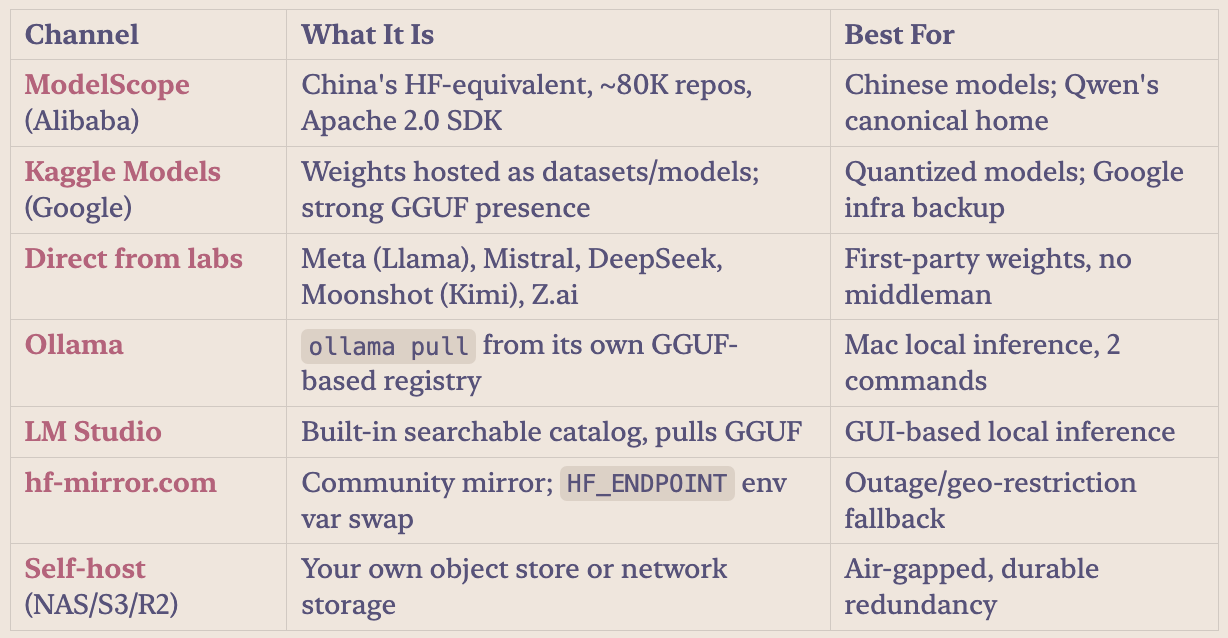
The good news is that open-weight models are not hostage to Hugging Face. They are downloadable from multiple independent sources, and most are already mirrored in places that don't depend on a single platform or a single jurisdiction.
Here's what the alternatives landscape looks like:
The practical discipline that protects you:
The default Hugging Face cache at ~/.cache/huggingface is scratch space, not a backup. It can be cleared, corrupted, or — under new ownership — subject to terms changes you don't control.
Pull the models you depend on into storage you control:

This copies weights out of the cache into folders you own. Pin specific commit hashes or version tags in any production dependency. Set a ModelScope fallback via HF_ENDPOINT=https://hf-mirror.com for emergency access when your primary hub is unreachable.
This is not a panic move. It's standard hygiene for dependencies you actually rely on.
The Bottom Line
The open-weight AI town square is about to get a new landlord. The deal is not done, the regulators aren't done, and the geopolitical pressure is mounting from both sides of the Pacific.
But the strategic direction is clear regardless of outcome: distribution-layer concentration is real, platform neutrality is fragile, and the models you build your local stack on are contested assets in a much bigger game.
The move that costs you nothing and protects you from every scenario is diversification. Mirror your weights now. Own your backups. And treat every platform as a convenience, not a dependency.
That's always been the right posture for open-source infrastructure. This deal just made the lesson unavoidable
Sources: The Information (Aug 26), Business Insider (Aug 27), Bloomberg (Aug 27), TechCrunch (Aug 26), Fortune (Aug 27), The New Stack (Aug 27), Tech Insider (Aug 28), The Hill (2026), Sheppard Mullin (2026), The Next Web (Jul 7, 2026), TechTimes (Jul 11, 2026), Data Gravity (2026). All deal status reports are unconfirmed — see individual sources for detail.