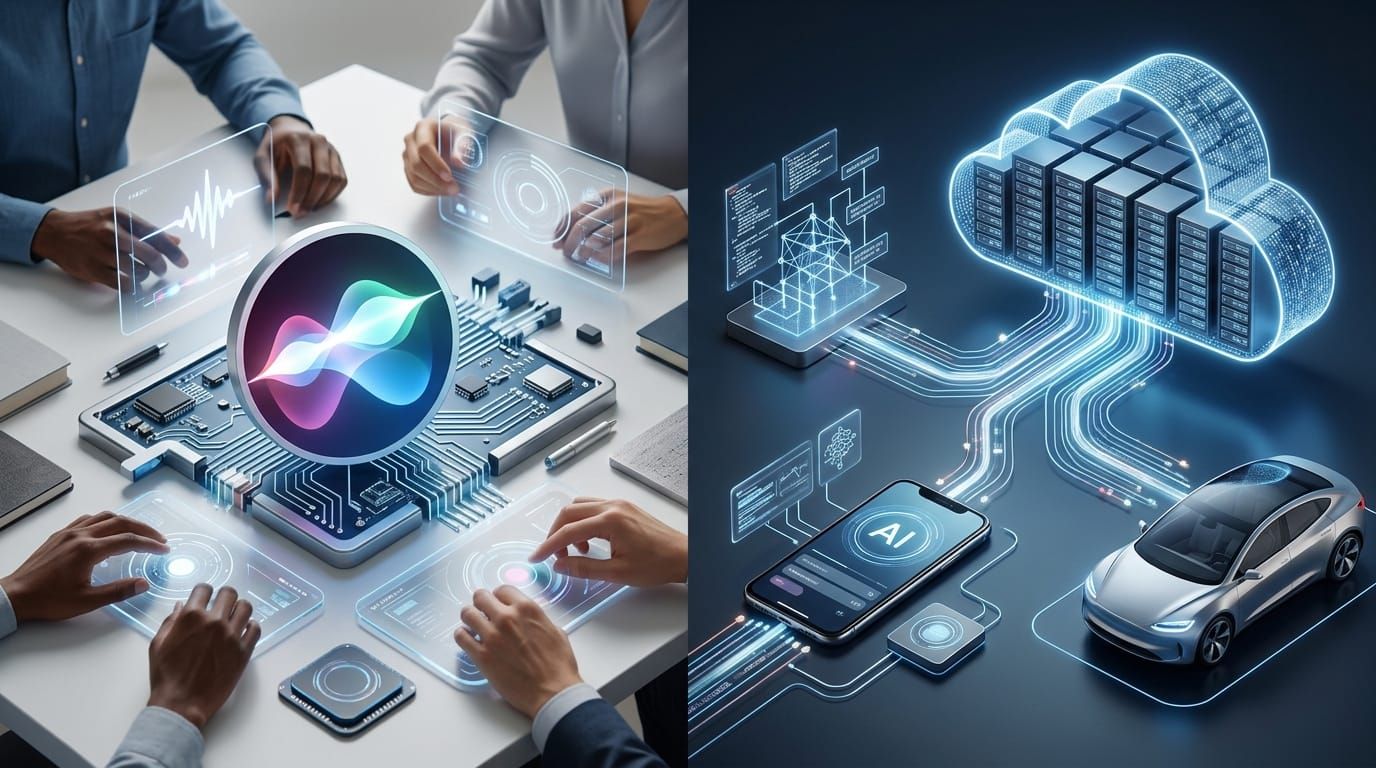
Here's the tension: Apple is spending roughly a billion dollars a year to reinvent the assistant in your pocket, and most people still don't think of Apple when they think of AI. As of May 2026, only 4% of U.S. consumers named Apple Intelligence when asked which AI they think of first. ChatGPT got 33% (Morning Consult, May 2026, via Dazzle). On September 14, Apple gets its chance to change that number.
That's the day iOS 27 ships, bringing Siri AI — a ground-up rewrite of the assistant Apple has promised since 2024. This isn't a spec-sheet story. It's a story about where AI runs, who you trust with your questions, and whether "AI on my device" finally means something to everyday people.
What Apple actually shipped
Apple announced Siri AI on June 8, 2026, at its Worldwide Developers Conference (Apple Newsroom, June 8, 2026). This is a full rebuild, not an upgrade: personal context understanding, broad world knowledge, awareness of what's on your screen, a dedicated app, expanded Visual Intelligence, and integrated writing tools. It spans iPhone, iPad, Mac, Watch, AirPods, CarPlay, and Vision Pro, with an English-first rollout (Apple Newsroom, June 8, 2026).
Two things make this different from anything Apple has done in AI.
First, Apple partnered with its biggest rival. On January 12, 2026, Apple and Google announced a multi-year deal: the next generation of Apple Foundation Models will be built on Google's Gemini models and cloud technology (Google/Apple joint statement, Jan 12, 2026). Bloomberg reported a roughly $1-billion-a-year license for a custom Gemini model of 1.2 trillion parameters a figure Apple has never confirmed (Bloomberg via CNBC, Jan 12, 2026). Apple's existing ChatGPT integration stays. But Gemini is now the engine room.
Second, Apple built genuinely unusual hardware engineering. Its most powerful on-device model, called AFM 3 Core Advanced, is a 20-billion-parameter multimodal model but it doesn't live in the phone's memory chips the way models normally do (Apple Machine Learning Research, June 8, 2026). The full model sits in flash storage, the same kind of memory that holds your photos. When you ask a question, a router on the device pulls only the parts it needs into active memory between 1 and 4 billion parameters per request. Apple calls the technique Instruction-Following Pruning. It lets a phone run a model far bigger than its memory allows (Apple Machine Learning Research, June 8, 2026).
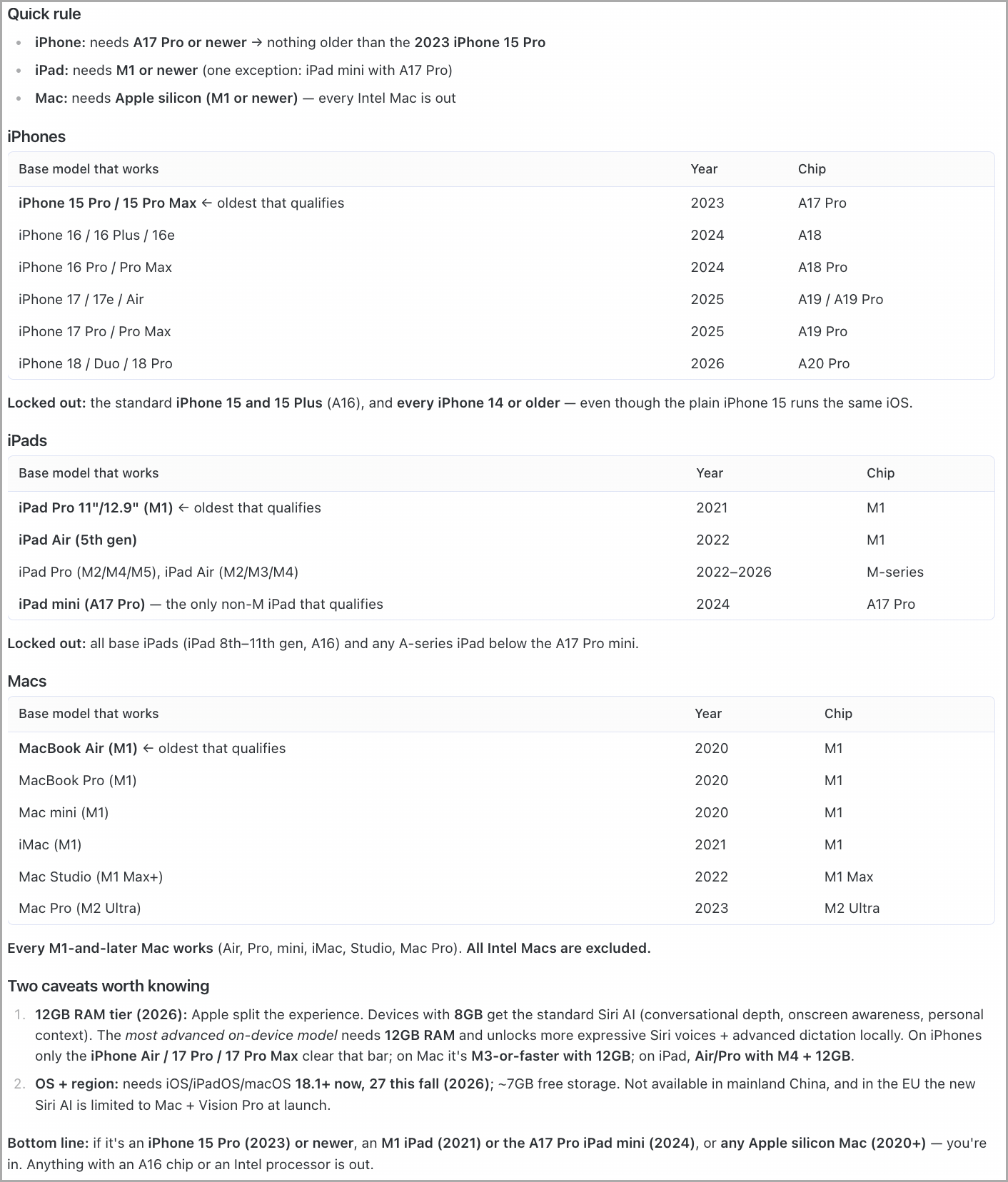
The catch is hardware. The full on-device experience requires an iPhone Air, iPhone 17 Pro or Pro Max, an iPad with M4 and 12GB of memory, or a Mac with M3 and 12GB (Apple Newsroom footnote, June 8, 2026). Older phones get the cloud version Apple says it runs in expanded Private Cloud Compute, now hosted on NVIDIA GPUs in Google Cloud (Apple Security Research, June 8, 2026).
Why "runs on my device" is the real story
Here's what all that engineering is really selling: privacy.
The numbers show why Apple needs this story. A September 2024 YouGov survey found 62% of newer iPhone owners viewed smartphone AI as "another way for companies to collect their data" (YouGov, Sept 2024). Meanwhile, 70% of Americans say they distrust companies' AI decisions, and 57% see AI data collection as a privacy threat (Dazzle, "29 On-Device AI and Data Privacy Statistics"). That distrust is Apple's wedge.
The pitch goes like this: when AI runs on your device, your questions stay on your device. Your messages, your calendar, your photos they never leave to be processed on someone else's servers. Apple is betting that "on-device equals private equals trustworthy" becomes the way mainstream people think about AI.
One honest caveat: on-device doesn't mean unhackable. Security researchers reported a 76% success rate jailbreaking Apple Intelligence's on-device model across 100 tests (Fox News Tech, 2026) a single report, not peer-reviewed, but a reminder that "private" and "impenetrable" are different words.
Still, the strategic bet is clear. Apple is the first major company to make where AI runs device versus cloud the center of its consumer story, rather than an engineering footnote.
What this means for the local-AI narrative
My read: this is a two-lane strategy, and the lanes tell you everything.
Lane one is capability. Apple licensed Gemini's biggest models because it needed world-class answers now. The cloud handles the heavy lifting. Lane two is trust. The on-device model exists so the most personal tasks dictation, messages, photos never leave your phone. Apple isn't picking a side. It's selling a trade-off: raw power when you want it, local control when you need it.
That trade-off is what matters most for where this technology goes. For years, the AI industry has competed on who has the biggest, smartest model. Apple is competing on something else: who can make AI feel safe enough to use for the intimate stuff. That's a different game, and it's the one people over 50 will most appreciate. We remember life before everything was connected.
But the honest history check cuts both ways. Apple Intelligence launched in late 2024 with iOS 18.1 and promptly missed its own deadlines. In March 2025, Apple admitted the flagship Siri features would take longer than promised (Apple statement, via Daring Fireball and CNBC, March 7, 2025). The delays triggered a class-action lawsuit from iPhone 16 buyers over features advertised but not delivered (Fortune, Jan 13, 2026). John Gruber, a longtime Apple watcher, said most of it felt like Apple shipped it "a year ahead of the company's usual level of baked-ness" (Daring Fireball, March 7, 2025).
So September 14 answers a real question: turning point, or mirage? The plumbing is built. The engineering is genuinely clever. But Apple Intelligence holds 4% mental market share against ChatGPT's 33% (Morning Consult, May 2026). The trust story hasn't been converted into usage yet. Siri AI has to feel much better on day one, or the billion-dollar bet just buys a third year of "Apple is behind."
What to watch next
Three things, in order of importance:
- Does it work on launch day? Watch the reviews in the first two weeks. Apple's history here is the headline risk. One solid week of "it just works" reviews changes the narrative more than any spec.
- Do the awareness numbers move? Morning Consult's May 2026 data is the baseline: 27.4% awareness, 4% mindshare (Morning Consult, May 2026, via Dazzle). If those numbers budge by year-end, the perception shift is real. If they don't, Apple has a messaging problem money can't fix.
- Which lane wins? Watch whether competitors copy the two-lane model, a big cloud brain plus a private on-device brain. If Google and Samsung start leading their marketing with on-device privacy, you'll know Apple found the nerve. If they keep leading with model size, Apple's bet hasn't moved the industry.
For those of us who remember when "smart" meant a device that worked without phoning home September 14 is worth watching. Not because of the specs. Because it's the first time a company with real reach is staking its reputation on the idea that your AI should live where you live.
If it lands, the way every company talks about AI changes with it.
This is the kind of shift I track at The Complex Bytes, what AI means for people who lived through every prior technology wave. If you found this useful, follow along and tell me in the comments: would you trust your phone's AI more if it never left the device?