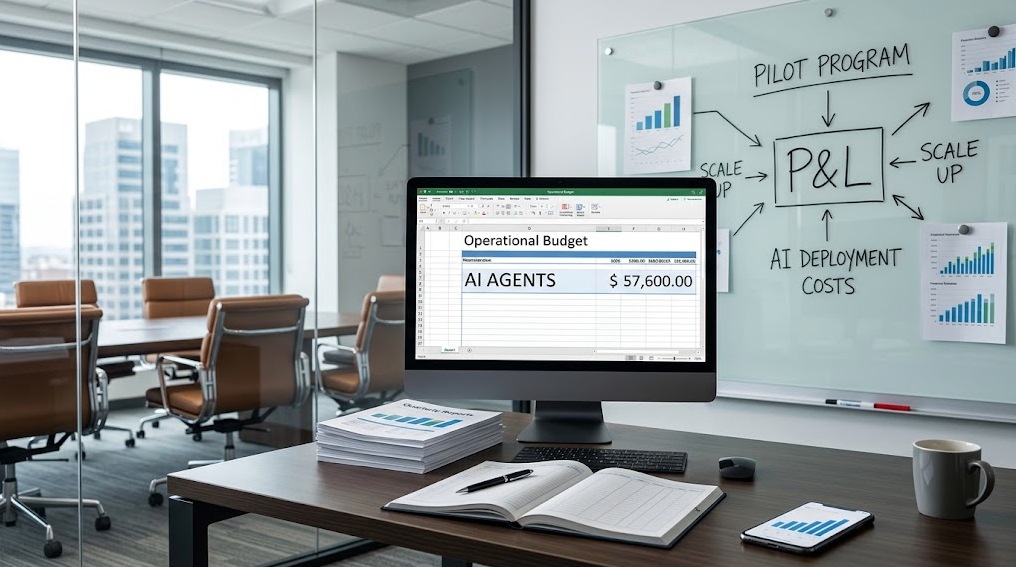
A lot of organizations have an AI pilot somewhere. Maybe marketing runs a chatbot. Maybe customer service has an agent that triages tickets. Maybe engineering tried an automated code reviewer.
That's not transformation. That's a science fair project.
Deloitte's 2026 Global Technology Leadership Study found that 58% of technology executives say their organizations are ready to build AI capabilities. But readiness and results are two different things. The same report flags a widening gap between companies generating real returns and those still stuck in the experimentation phase. Only 5% of companies have scaled AI in a way that shows up on the income statement.
The bottleneck isn't the technology. It's the operating model.
The Hub Problem
PwC's research tells a similar story. Their AI studio model — a centralized hub for building, testing, and deploying AI agents — has become a reference architecture for companies trying to move past the pilot stage. The idea is simple: instead of letting every department run its own isolated experiment, you create a shared center with standardized tools, governance frameworks, and deployment protocols.
PwC found that companies investing more than 0.5% of revenue in AI outperformed their sector's median total shareholder return by 21% between 2022 and 2025. Those that invested less underperformed by 2%. The difference wasn't the amount spent. It was the approach.
The AI studio model works because it solves three problems that kill most pilots:
Governance. Who owns the risk when an agent makes a bad call? A centralized hub builds oversight into the process from day one.
Reuse. A chatbot built for customer service shouldn't stay in customer service. The hub makes it easy to adapt and redeploy.
Measurement. When every team uses different tools and metrics, you can't compare results. A hub enforces consistent ROI tracking.
One Core Function, Fully Redesigned
The move from pilot to P&L starts with one function. Pick a department where the data is clean, the workflows are documented, and the potential savings are visible. Customer service is a common first choice. Marketing operations is another.
Design the new workflow end to end. Don't add an AI agent to the existing process. Rethink the process itself. What tasks disappear? What decisions change? Who needs new skills?
Deloitte calls this "rewiring the operating model." PwC calls it an "enterprise-grade operating framework." Both mean the same thing: AI agents change how work gets done, not just how fast.
Actionable close: Pick one department in your business. Map its core workflow on paper. Circle three tasks an agent could handle. Now redesign that workflow from scratch — don't just add AI to the old process. That single-function rewrite is your proof of concept for the whole organization.