Reference: This post assumes familiarity with FedRAMP's official program pages. For primary-source detail as you work through the checklist below, keep these open: FedRAMP 20x program overview, CR26 announcement, and NIST's OSCAL project site.
January 1, 2027, is not a distant deadline. It is sixteen Tuesdays from now. On that date, the Consolidated Rules for 2026 (CR26) become mandatory for every stakeholder in the FedRAMP ecosystem. If you hold a current Rev 5 certification, your first annual assessment after that date will be judged against the new rules. If you are entering fresh, 20x is the only path that makes sense. And if you are waiting to see how things shake out, you are building a delay into your own certification timeline that you may not have budgeted for.
I have been through enough federal IT transitions to know the pattern. First comes the awareness gap — "I heard something changed." Then comes the action gap — "I need to figure out what this means for me." Then comes the panic gap — "I should have started six months ago."
This post is for people in the second gap. You know FedRAMP 20x is real. You have probably read the explainers about the vocabulary shift — Authorization becoming Certification, impact levels becoming Classes A through D, OSCAL replacing narrative System Security Plans (SSPs). Good. That context matters. But knowing the new words is not the same as knowing what to do about them.
Here is the self-assessment. No fluff. No vendor pitches. Just the checklist I would use if I were preparing a cloud service provider (CSP) for the 20x transition today.
The Timeline — What Is Actually Coming
Before the checklist, get these three dates in your calendar. They are the ones that will determine your transition velocity.
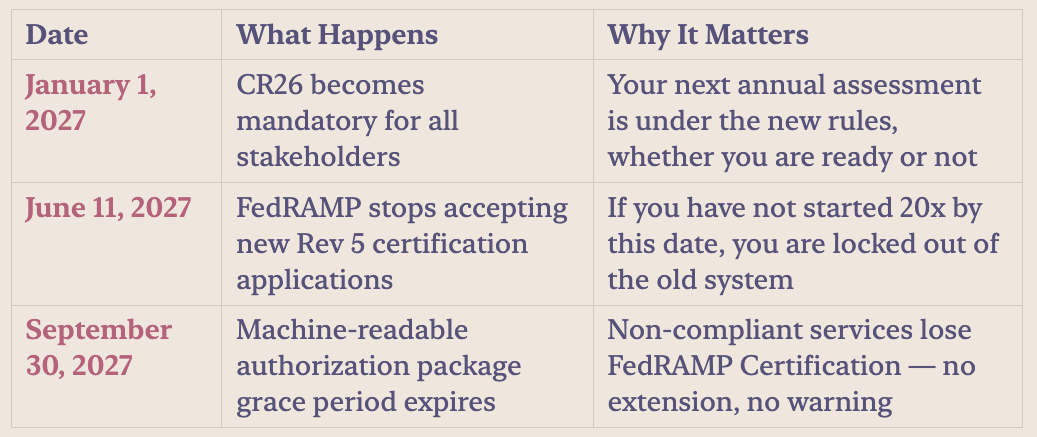
The September 2027 date is the one that will catch the most organizations. The FedRAMP Program Management Office (PMO) has been clear: after this date, if your compliance package is not in machine-readable format (OSCAL), your certification is revoked. Not suspended. Not "pending review." Revoked.
The Readiness Checklist — Start Here
This checklist is organized by timeframe. Do not try to do everything at once. Pick your track, identify what applies to your situation, and work the list in order.
This Month (September 2026)
1. Lock your track — 20x or Rev 5, deliberately.
If you are new to FedRAMP, the answer is 20x. The PMO wants new entrants on the new system. The old Ready pipeline closed July 28, 2026. Class A is available now as an on-ramp if you hold a SOC 2 Type II, and it buys you a two-year window to reach a higher class.
If you are mid-authorization with an active agency sponsor on Rev 5, finish what you started. Switching mid-process means starting over, different evidence model, different assessment format. But plan your 20x transition in parallel. Do not let a completed Rev 5 certification become a reason to delay the inevitable.
If you hold an existing Rev 5 certification, you are in the best position. Your certification remains valid. No forced re-authorization mid-cycle. But your first annual assessment after January 1, 2027 will use CR26 rules. Calendar that assessment date and work backward.
2. Choose your class — not by default.
Do not default to whatever your old Rev 5 baseline was. Map your actual data sensitivity, your customer requirements, and your growth plan against the four classes:
- Class A: Entry-level. Mature security program, limited federal use. SOC 2 Type II gets you in.
- Class B: Low-risk, limited-use services. Think old Low and Li-SaaS baselines.
- Class C: Common enterprise services. The old Moderate. This is where most CSPs will land.
- Class D: Most sensitive systems. The old High. The 20x Class D path is not defined yet — planned for a pilot in early 2027.
A common mistake: picking Class B because it looks cheaper, when your customer base needs the security controls at Class C. Another: over-committing to Class D when you do not need it yet, carrying overhead that slows your whole operation. Start at the lowest class that supports your business need. You can upgrade.
3. Kill the Word SSP.
This is the hardest change for most organizations. If your compliance process today starts with a Word template and a control narrative, you are building the wrong artifact for 20x. Under the new model, your compliance package is a data product, not a document. It lives in OSCAL — the Open Security Controls Assessment Language — and your evidence comes from automated pipelines, not from a person compiling a quarterly report.
OSCAL is not one file format — it is a stack of layers, each building on the one below it: a Control Layer (the catalog of controls and the profile that tailors them to your baseline), an Implementation Layer (your System Security Plan and component definitions), and an Assessment Layer (assessment plans, results, and your Plan of Action and Milestones). The diagram below, from NIST's official OSCAL documentation, shows how information flows up through those layers and traces back down for accountability:
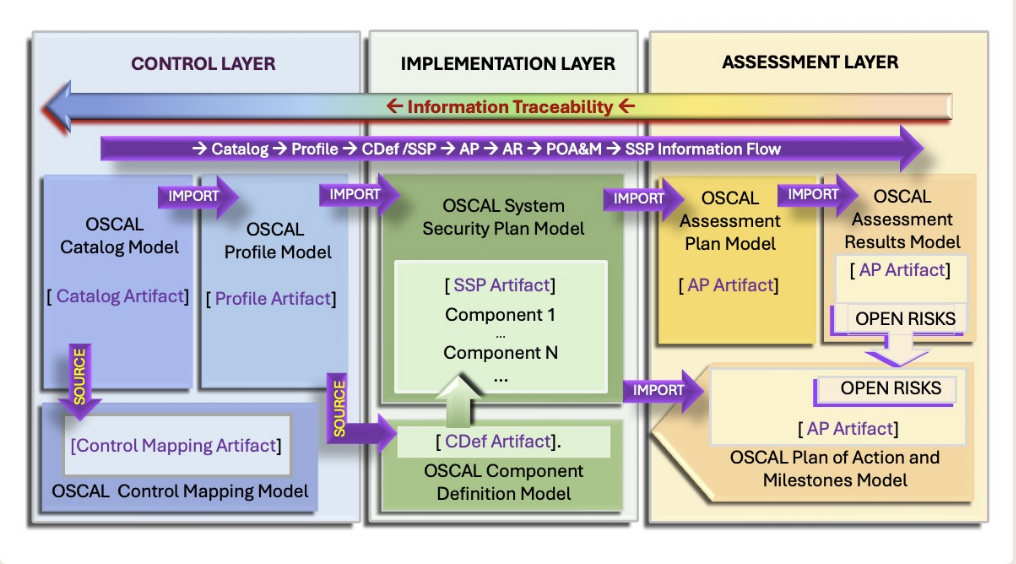
If that diagram is new to you, bookmark the NIST OSCAL Layers and Models page — it is the clearest primary-source explanation of how a catalog becomes a profile, how a profile becomes an SSP, and how an SSP eventually produces assessment results and open risks. Your engineering team will reference it more than once while building the pipeline below.
I understand the instinct to keep doing what works. Word-based SSPs have been the standard for over a decade. But here is the reality: in 2025, FedRAMP processed over 100 Rev 5 authorizations without a single machine-readable submission. That grace period ends in 12 months. Start the OSCAL pipeline build now. Even Rev 5 providers need this — the machine-readable requirement applies to everyone, and the clock is the same.
This Quarter (September–December 2026)
4. Build the evidence pipeline.
Identify every data source in your environment that can automatically prove a control is functioning. Identity provider logs. Encryption configuration scans. Vulnerability scanner output. IAM event streams. Endpoint detection and response (EDR) telemetry. Configuration management databases. These become your Key Security Indicator (KSI) data sources.
Under FedRAMP 20x, the government expects your Key Security Indicators to be validated automatically and persistently. Not sampled. Not manually compiled. Validated by automated methods that run continuously.
The KSI automation requirements are tiered by class:
- Class A: May implement automated methods (optional)
- Class B: Should implement at least one automated method per KSI
- Class C: Must implement at least two automated methods per KSI
- Class D: Must implement at least four per KSI (path not yet available)
The SHOULD versus MUST distinction matters. Class B says "should" — and in practice, the PMO expects it. Class C says "must" — you will be rejected without it. And Class C's two methods must be genuinely independent. Not the same data source queried twice. An identity provider report plus an independent configuration scanner confirming that no accounts bypass the policy. The second method must corroborate independently.
5. Start collecting KSI metrics now.
Class C requires at least six months of historical KSI validation data. Not a best practice. A requirement. If you start collecting today, you are ready by March 2027. If you wait until you need certification, you have created your own six-month delay.
Even if you are targeting Class B initially, start storing the metrics. You will need the history when you upgrade to Class C, and the data gives you a baseline to debug automation gaps while the stakes are low.
6. Implement SBOM with VEX.
Software Bill of Materials (SBOM) generation is not optional under 20x. FedRAMP requires SBOMs in CycloneDX 1.6 or SPDX 3.0, cryptographically signed, updated on every production deployment. And SBOMs must include VEX (Vulnerability Exploitability eXchange) statements — so the government knows not just what software you are running, but which vulnerabilities actually matter in your specific configuration.
If you are shipping quarterly SBOMs in custom JSON without VEX, the PMO's automated review will flag the gap in seconds. This is not a future requirement. It is current.
7. Map your controls against the published KSI library.
FedRAMP has published the KSI library. Sit down with your current control set and map each one against the KSI themes — Identity and Access Management (IAM), System and Communications Protection (SC), Configuration Management (CNA), Machine Learning Assurance (MLA), and others. Identify gaps now, before you engage an assessor. Every gap you find today is a gap you can close on your own timeline. Every gap an assessor finds is a delay you did not plan for.
By Q1 2027
8. Engage a 3PAO that understands the 20x model.
The Third Party Assessment Organization's role has shifted under 20x. They are not there to verify that you wrote good narratives. They are there to verify that your automation works. That your KSI validation methods are genuinely independent. That your OSCAL pipeline produces valid, ingestible packages.
Not every 3PAO understands this distinction yet. Ask specific questions during your selection process: "How many 20x assessments have you completed? How do you evaluate KSI automation independence? What is your process for validating machine-readable packages?" If the answers are vague, keep looking.
9. Coordinate with your agency sponsor(s) early.
Under the 20x model, FedRAMP certifies. Agencies still authorize. And agency reviewers trained on Rev 5 packages need time to get comfortable evaluating KSI-driven artifacts. Expect uneven readiness across agencies through at least mid-2027.
Get ahead of this. If your agency sponsor has not reviewed a 20x package yet, offer to walk them through it. Share your OSCAL pipeline output early. The goal is zero surprises on assessment day.
10. Test your machine-readable package end-to-end.
Before your formal assessment, generate a complete certification package from your OSCAL pipeline. Validate it against the CR26 JSON schemas. Confirm it can be ingested by agency tools. Do this while the timeline is still yours to control.
A failed ingestion test during your assessment is a delay. A failed ingestion test during your own dry run is a Tuesday.
What Changes for Already-Authorized vs. New Entrants
If you already hold a Rev 5 certification, your situation is better than you think. Your certification remains valid through its cycle. You are not required to re-authorize early. Balance Improvement Releases (BIRs) already apply to Rev 5 providers — Significant Change Notifications, Minimum Assessment Scope, Collaborative Continuous Monitoring, Vulnerability Detection and Response, Authorization Data Sharing. You have already absorbed some of the CR26 changes without realizing it.
Your investment is still real. Your SSP-in-Word workflow will be obsolete within 18 months. But you have a transition window, and you can plan it on your own calendar.
If you are entering fresh, 20x is the primary path. No agency sponsor is needed for 20x — that alone removes the single biggest barrier to entry for most CSPs. Start with OSCAL from day one. Building a Word SSP first and converting later is the most expensive mistake you can make. You will pay for the conversion effort twice.
Common Readiness Gaps — What Catches People
Across the compliance advisory sources I track, these eight gaps appear consistently:
- Still building an SSP in Word. If your compliance process starts with a document template, you are building for a system that is closing, not the one that is opening.
- Treating compliance as a documentation exercise. CR26 is the first FedRAMP rulebook that assumes you have an API for your security posture, not just a Word document about it. Evidence generation is an engineering deliverable now.
- No SBOM pipeline. A vendor shipping quarterly SBOMs in custom JSON without VEX will fail 20x intake. The automated review flags it immediately.
- No historical KSI metrics. Class C requires six months of history. Start collecting now or accept a six-month delay.
- Choosing the wrong class. Defaulting to your old baseline instead of mapping to actual customer needs and growth plans.
- No independent second validation method. Class C requires two methods that corroborate independently — not the same data queried twice.
- Agency unfamiliarity with 20x packages. Twenty-x packages look different than what agency reviewers are used to. Plan for education time.
- Using old checklists. FedRAMP Ready is gone. Provisional Authority to Operate (ATO) is retired. The JAB was discontinued in 2024. Any checklist built on these terms is stale. Start fresh.
The Bottom Line
FedRAMP 20x is not a compliance tweak. It is an engineering transformation. The organizations that treat it that way from the start will be certified while their competitors are still writing their first SSP in Word.
Your single most important action this quarter is straightforward: stop treating FedRAMP as a compliance project and start treating it as an engineering program. Build the OSCAL pipeline. Start collecting KSI metrics. Implement SBOM with VEX. Choose your class deliberately, not by default.
January 1, 2027, is sixteen Tuesdays away. The clock is running for everyone the same way. What matters is whether you use those sixteen weeks to build infrastructure — or to wonder where the time went.
This article is based on analysis of FedRAMP's published CR26 rules, the FRC-CSX-VVK KSI automation requirements, and verified guidance from compliance advisory sources. Class D 20x path dates and exact agency adoption rates remain unconfirmed as of this writing — expect updates as the PMO publishes additional guidance.
Further Reading — Primary Sources
- FedRAMP 20x program page — official policy, KSI library, and class definitions
- FedRAMP: "Propelling Change" — CR26 launch announcement — the source announcement for the dates in this post
- NIST OSCAL project home — the machine-readable language underpinning every 20x package
- NIST OSCAL — Layers and Models — the Control/Implementation/Assessment layer breakdown referenced above
- NIST OSCAL — Control Layer overview — catalog and profile models in depth